-
Coastal Mountain Hemlock
Back to Web Atlas
Coastal Mountain Hemlock
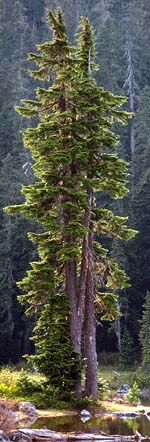
The Mountain Hemlock, Tsuga mertensiana, A close relative of the more dominant Western Hemlock. A medium-sized tree, it usually grows up to 50 meters tall and 1.5 meters in diameter at the base.
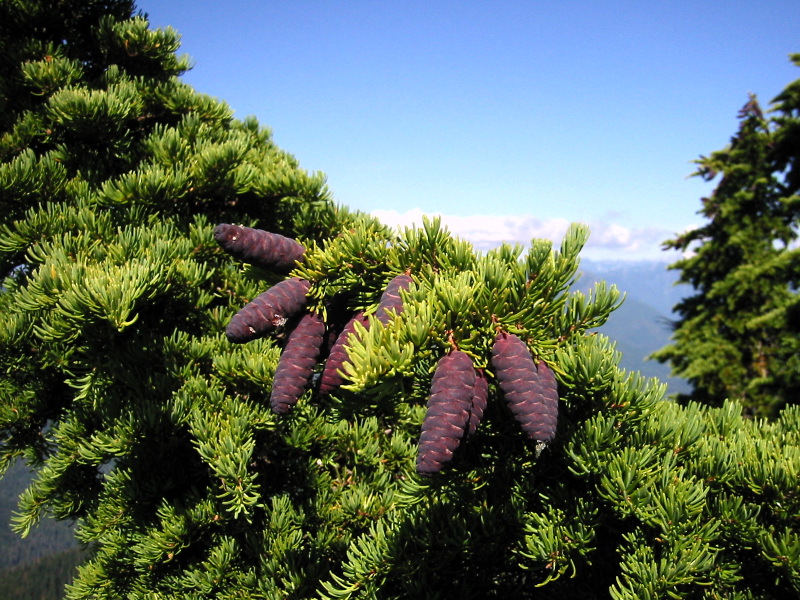
Native to the west coast of North America, the bark of the mountain hemlock is thin and gray in color. Its crown is in a conic shape in young trees and gradually taking on a cylindrical shape as the tree grows. Its needles are soft, blunt-tipped, and slightly flattened. The cones are small but long.
The mountain hemlock prefers open conditions with sufficient light, and it can tolerate severe, cold weather better than many other species. The mountain hemlock is well adapted to deal with heavy snow fall and ice formations.
Range
The Mountain Hemlock shares much territory with the Western Hemlock. In Alaska and BC, and northern Washington, mountain hemlocks can be found from the sea level up to about 1000 m of elevation. Going further south, it can be found between 0-2300m in Oregon and Northern California, and between 2500-3200m elevation in the Sierra Nevada area.
As the mountain hemlock grows to the treeline on the coastal mountain slopes, the best place to find its picturesque qualities are in the high mountain areas.
The Mountain Hemlocks - Vancouver's Stanley Park on a rainy day in 1999; Picturesque shot next to an alpine lake - click to see the full pictures


Climate
In BC, mountain hemlocks are found on the western slopes of the coastal mountains where there is plenty of precipitation. The winters are long, wet and mild, optimal for the hemlock's growth, summers are relatively short, sunny and dry.
Vegetation
Other than the hemlock, there are many other species of flora that occupies the forest floor. Ferns, mushrooms, shrubs, vines, birch trees, berries all compete for space under the protective umbrella the Mountain Hemlock forest offers.
Mountain Hemlock - mature tree; branches; purple cones; mature cone in spring; new cones in autumn - click to see the full pictures



Wildlife
Almost identical in range to the western hemlock, within the mountain hemlock's range the apex animal species are also the cougar (Puma concolor), the black bear (Ursus americanus) and the grizzly bear (Ursus arctos horribilis). Cougars are mammals of the Felidae family native to both North and South America. Closely related to the domestic cat, cougars are a very capable predator that stalk-and-ambush their prey.
The black bear and the grizzly bear are omnivores that feed on a variety of sources. These three species are competitors for territory and food supply, and may prey on each other's cubs in certain encounters.
Other species include the salmon, deer, elk, Vancouver Island Marmots, and many other animals.
Bears - Adult male; tracks on a gravel beach - click to see full pictures


Grizzly bear - a movie illustrating the bear hunting salmon in a stream - click to activate the movie and view
Resources
The wood of Mountain Hemlock is not as suitable as the Western Hemlock when used for timber and pulp. However, being able to adapt to a variety of climate conditions makes the Mountain Hemlock a very popular ornamental tree in gardens.